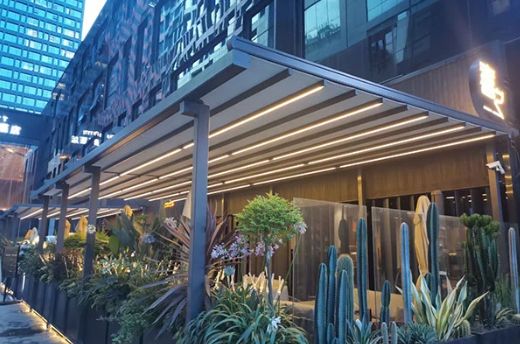
A terrace can look valuable on a floor plan and still sit empty for most of the afternoon. Direct sun makes tables and paving uncomfortable. Guests keep moving chairs to chase a narrow strip of shade. A fixed canopy solves the heat but removes the open-sky feeling on pleasant days. When light rain arrives, staff rush to move cushions and reset tables. The outdoor area exists, but its usefulness changes with every hour of weather.
A motorized retractable roof awning addresses that problem with adjustable overhead coverage. The fabric roof extends along aluminum guide rails when shade or limited weather protection is needed, then retracts when users want daylight, ventilation and an open view. The result is not a sealed indoor room; it is a more flexible outdoor space.
The short answer
Motorized retractable roof awnings are rail-guided fabric roof systems for patios, gardens, restaurants, hotels and commercial terraces. They solve the gap between permanent roofing and completely exposed outdoor seating: users can extend overhead protection for strong sun and suitable light-weather conditions, then retract it for open sky. Correct results depend on the span, projection, fabric, drainage, frame, fixing surface, motor and local exposure being reviewed as one system.
Why fixed shade is often the wrong answer
Outdoor comfort is not constant. A west-facing restaurant may need strong afternoon shade but welcome morning daylight. A residential patio may need coverage in summer and an open view in mild weather. A fixed roof provides certainty, but it also fixes the space in one condition.
External shading works before unwanted solar radiation reaches the protected surface. The U.S. Department of Energy explains that exterior overhangs and sunscreens can reduce undesirable solar heat gain, while the best strategy still depends on climate, orientation and the whole building design. The Whole Building Design Guide also emphasizes orientation-specific sun control rather than treating every façade and outdoor area alike.
How a motorized retractable roof works
A typical system combines an aluminum support structure, guide rails, crossbars, outdoor roof fabric, a motorized drive, drainage components and project-specific fixings. The motor moves the fabric and supporting crossbars along the rails. When extended, the roof creates overhead coverage; when retracted, the fabric gathers at one end to reopen the sky.
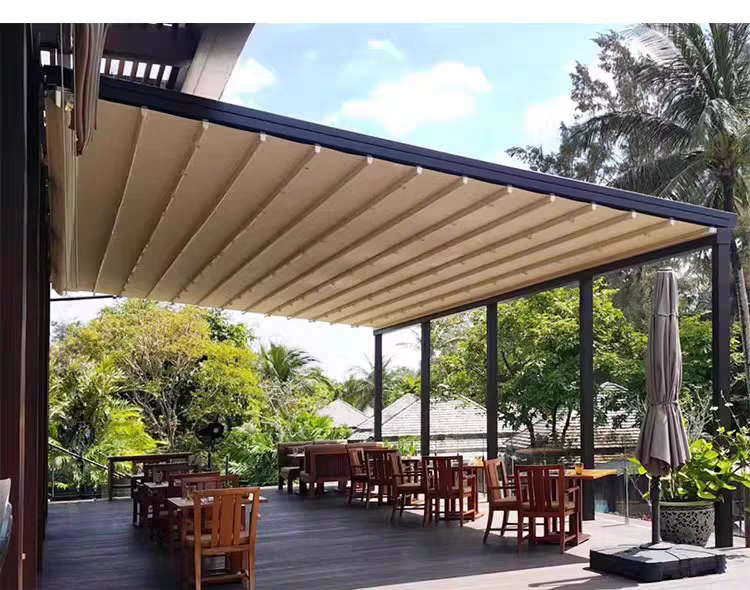
The motor is only one part of the result. Roof pitch, water direction, module width, projection, post position, cable route and service access all affect daily use. Large projects may need several coordinated modules rather than one oversized unit.
7 everyday problems a motorized retractable roof awning can solve
1. Direct sun makes the terrace too hot to use
An outdoor dining or seating area can become uncomfortable long before the indoor space does. Direct sunlight heats tables, cushions and paving, while glare makes menus, laptops and conversations less pleasant. People gradually move away from the exposed seats.
Extending the roof places shade above the occupied area. Because the system is retractable, the owner can respond to changing sun instead of accepting permanent darkness. Orientation and roof projection still matter: morning and late-afternoon sun may also require side protection.
2. A permanent canopy blocks the open-sky experience
A solid roof is useful when continuous coverage is the priority, but many gardens, courtyards and rooftop spaces are attractive precisely because they feel open. A permanent canopy can reduce daylight and make a façade or small patio feel visually heavy.
A retractable fabric roof preserves choice. Open it on mild mornings and clear evenings; extend it when overhead conditions become uncomfortable. This adjustable character is the main advantage—not a claim that the fabric roof replaces a conventional building roof.
3. Restaurant seating becomes unreliable throughout the day
For hospitality operators, a terrace that works only in perfect weather creates operational problems. Reservations are harder to plan, staff repeatedly move tables, and guests receive a different experience depending on seat location.
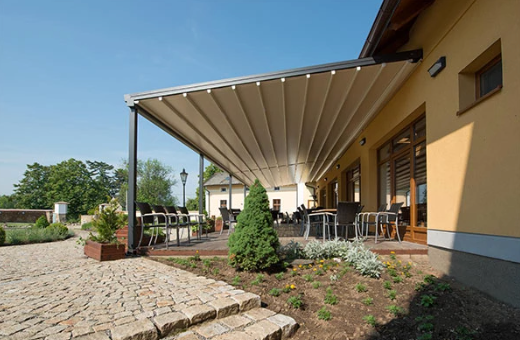
Motorized coverage allows staff to adjust the roof without manually handling a large fabric panel. For multi-module installations, control groups, operating procedures and safe weather limits should be agreed before production so that the team knows when and how to operate each bay.
4. Light rain forces an immediate retreat indoors
A short, light shower can interrupt an otherwise pleasant outdoor service. A suitably specified roof fabric, pitch and drainage route can provide useful overhead protection in approved conditions, buying time and reducing disruption.
That does not make the terrace waterproof in every storm. Wind-driven rain may enter from open sides, fabric and drainage limits are project-specific, and extreme weather requires retraction according to the confirmed operating guidance. Floors, gutters and downpipes must still direct water safely away from people and the building.
5. Large manual covers are too inconvenient to adjust
Retractable shade only creates value when people actually operate it. A heavy or awkward manual cover is often left extended for weeks, even when open sky would improve the space. In a restaurant, staff may avoid an adjustment during busy service.
A motorized drive makes regular adjustment more practical. Wall switches, remote controls and compatible grouped-control arrangements can be planned for the application. Electrical supply, motor position, cable protection and access for future servicing must be included in the drawings.
6. A generic awning cannot cover the required span
A small residential patio and a deep commercial terrace do not place the same demands on rails, posts and crossbars. Trying to stretch one profile system across every opening can lead to poor proportions, difficult drainage or unsuitable support conditions.
LINGYUE offers project-configured T700, T900 and T1200 retractable roof series with different aluminum component sizes for different spans and installation conditions. Selection is based on dimensions, layout, local exposure and engineering review—not simply on choosing the largest model from a catalogue.
7. The roof, side screens, lighting and drainage are designed separately
Outdoor systems often disappoint at the interfaces. A post blocks a doorway, a gutter drains beside a table, a motor cable remains visible, or a side screen has no straight fixing surface because it was considered too late.
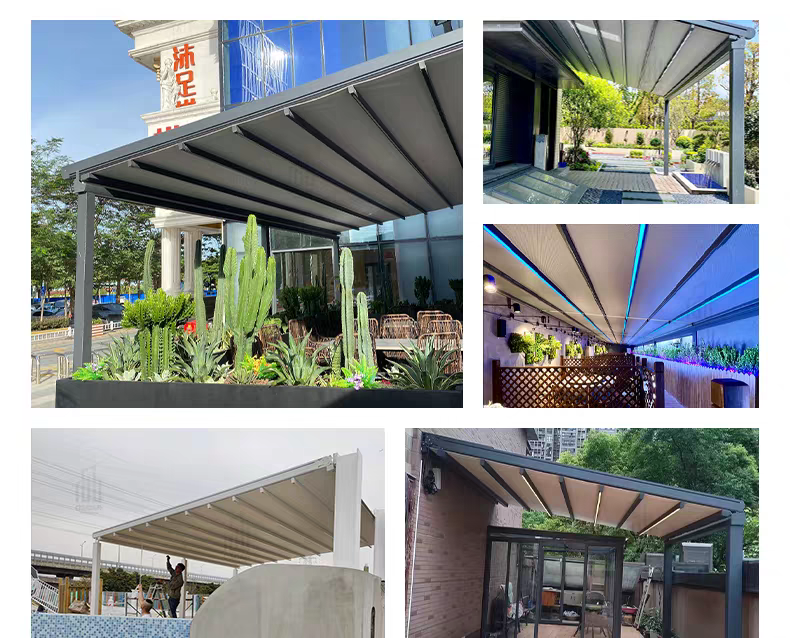
Planning the complete zone is more effective. A motorized zip screen blind can address side sun and exposed airflow, while the roof manages conditions above. Our guide to seven problems zip screens solve explains when that side protection adds value.
What a retractable fabric roof does not do
- It does not create a sealed, insulated room. Open sides and fabric construction behave differently from a conventional building envelope.
- It is not a universal storm solution. Operation must remain within the approved wind, rain and snow conditions for the exact system.
- It does not make drainage optional. Pitch, gutters, outlets and the surrounding floor must manage water together.
- It cannot compensate for unsuitable fixing. The supporting wall, slab or posts must be assessed before production.
- It is not maintenance-free. Fabric, rails, gutters, fasteners, motors and moving parts require inspection and cleaning.
Retractable roof, louvered pergola, cassette awning or parasol?
| Option | Best when | Main trade-off |
|---|---|---|
| Motorized retractable roof awning | Adjustable overhead fabric coverage is needed across a terrace or outdoor room | Weather limits and fabric drainage remain project-specific |
| Motorized louvered pergola | Rigid rotating louvers, integrated drainage and architectural roof control are priorities | Heavier structure and a different open-roof appearance |
| Motorized full cassette awning | Wall-mounted projecting shade is needed without front posts | Projection and exposure limits differ from a rail-guided roof |
| Cantilever parasol | Movable, localized shade and minimal construction are preferred | Smaller coverage and greater sensitivity to site operation |
If rigid adjustable louvers are a closer match, read our guide to the seven problems a motorized louvered pergola can solve.
10 questions to answer before requesting a quotation
- What are the finished width, projection and available installation height?
- Will the roof be wall-mounted, free-standing, combined or double-sided?
- Which direction receives the strongest sun and prevailing weather?
- Is the primary goal shade, suitable light-rain protection, open-sky flexibility or all three?
- Where should water drain, and can downpipes connect safely to the site?
- What wall, slab or foundation will support the frame and fixings?
- What power supply, motor side and control method are required?
- Are lighting, heaters, side screens, glazing or doors part of the same zone?
- What local structural, fire, electrical or planning requirements apply?
- How will modules be packed, delivered, lifted and installed at the destination?
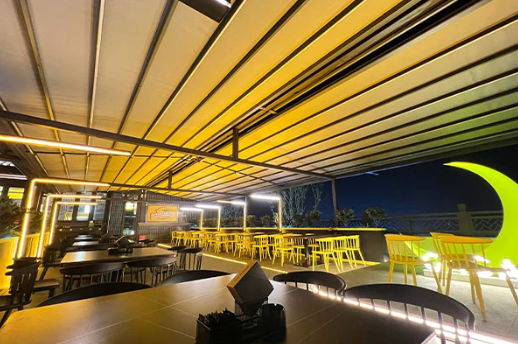
Why project review matters more than a generic size chart
The same dimensions can behave differently on a sheltered courtyard and an exposed rooftop. LINGYUE reviews the opening, projection, module layout, aluminum series, fabric, drainage, motor position, control method and fixing conditions before production. Buyers can examine our manufacturing capabilities, quality-control workflow and warranty and after-sales approach before starting a project.
Frequently asked questions
Can a motorized retractable roof awning be used in the rain?
A suitably specified roof can provide overhead protection in approved light-weather conditions, but it should not be described as universally waterproof or stormproof. Fabric, pitch, drainage, module size and wind exposure must be confirmed for the project.
Can it be attached to an existing building?
Often yes, when the façade or prepared structure provides suitable fixing and enough installation height. Clear site photographs, wall construction information and finished dimensions are required before confirming a wall-mounted layout.
What is the difference between T700, T900 and T1200?
They use different aluminum component sizes for different project scales and support conditions. T700 is a versatile series, T900 uses reinforced guide components for deeper applications, and T1200 is intended for substantial project-specific structures. Final selection requires engineering review.
Can several roof modules operate together?
Compatible motors can be arranged for individual or grouped control. Module count, control channels, electrical loads, cable routes and emergency operating procedures should be planned before production.
Can side screens be added later?
They often can, but planning them with the roof is better. Posts need straight fixing faces, the screen cassette requires clearance, and motor cables need a route. Early coordination reduces visible adaptations later.
What maintenance is required?
Keep guide paths and gutters free of leaves and hard debris, clean fabric according to its care instructions, inspect fixings and drainage periodically, and do not force the motor if movement is obstructed. Service access should remain available after installation.
Design the outdoor area around changing conditions
Send LINGYUE the width, projection, quantity, destination, application and site photographs. Our team will review the roof series, module layout, fabric, drainage, aluminum frame, motor position, fixing and control requirements.