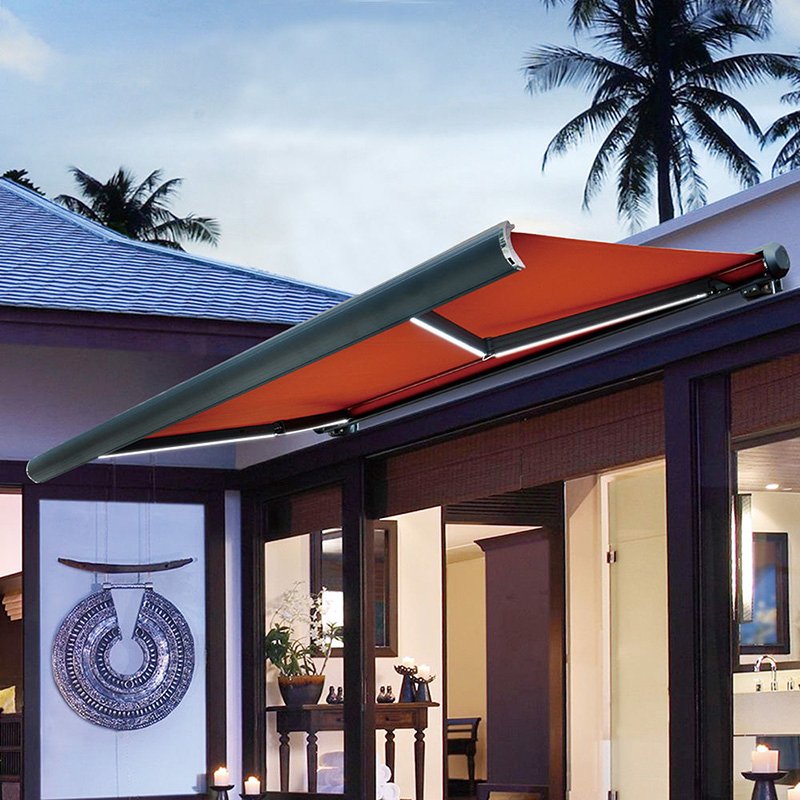
Awning vs canopy is not a cosmetic wording choice—it is a project decision that affects shade, rain management, wind exposure, structure and installation cost. Buyers often receive quotations for a retractable awning, rain canopy, fabric roof and pergola without being told that these systems transfer loads differently. The wrong choice can leave tables exposed to low sun, overload an unsuitable wall, trap water on fabric or create a product that staff are afraid to operate.
The pain point is simple: you need a comfortable outdoor area, but product names are used inconsistently. This professional awning vs canopy guide explains the terminology, compares nine technical differences and shows which LINGYUE outdoor shading system fits a balcony, patio, restaurant terrace or commercial façade.
Awning vs canopy: the short answer
An awning is normally attached to a building and projects outward to provide shade. A folding-arm awning can retract into a cassette and usually needs no front posts. A canopy is a broader term for overhead cover; it may be fixed or retractable and may use posts, guide rails or a self-supporting frame. A rain canopy is chosen around water shedding and structural support, while a retractable awning is primarily an adjustable solar-shading device. The right solution depends on projection, substrate, drainage, environmental loads and the user’s desired open-sky experience.
The distinction matters because exterior shading can stop solar radiation before it reaches the protected surface. The U.S. Department of Energy notes that exterior overhangs and sunscreens can reduce undesirable solar heat gain. The Whole Building Design Guide also stresses that an effective shading device must respond to façade orientation, climate and daylight—not only appearance.
Professional terminology buyers should understand
- Full cassette: an aluminum enclosure that protects the fabric roll and folding-arm mechanism when retracted.
- Folding arm: a spring-loaded articulated arm that extends the front bar and keeps fabric tensioned.
- Guide rail: a structural track that directs crossbars or a fabric roof along a defined path.
- Front bar: the leading aluminum profile attached to the outer fabric edge of an awning.
- Tubular motor: a cylindrical drive installed inside the fabric roll tube.
- Solution-dyed acrylic: exterior textile whose pigment is integrated into the fiber for color stability and UV resistance.
- Wind sensor / vibration sensor: control accessories that can initiate protective retraction when configured movement thresholds are detected.
These terms help a buyer compare an electric full cassette awning with a motorized retractable roof canopy on technical grounds instead of relying on a supplier’s product label.
9 critical awning vs canopy differences
1. Structural support and load path
A folding-arm awning normally transfers its self-weight, arm forces and wind actions through wall or ceiling brackets. This keeps the area below free of posts, but the substrate and anchors must be suitable. Hollow masonry, insulation systems, weak fascia boards and unknown concrete edges require special review.
A framed canopy can carry loads through posts, beams and foundations as well as a wall connection. The structure is visually heavier, but it can cover deeper areas and provide planned drainage. Environmental loads should follow the destination’s adopted code and engineering requirements; for context, ASCE 7 covers coordinated wind, rain, snow and other structural design loads. A catalogue wind claim is not a substitute for site-specific review.
2. Shade-first versus rain-management priorities
A retractable awning is principally a sunshade. It intercepts direct solar exposure and can reduce glare over windows, doors and seating areas. Some fabrics repel water and a correct inclination helps runoff, but wind-driven rain, side entry and product operating limits remain important.
A rain canopy or retractable roof is selected with the water path in mind: fabric direction, pitch, crossbar spacing, gutters, outlets and downpipes. It can offer more useful overhead coverage in approved light-weather conditions, yet it still does not create a universally waterproof storm shelter.
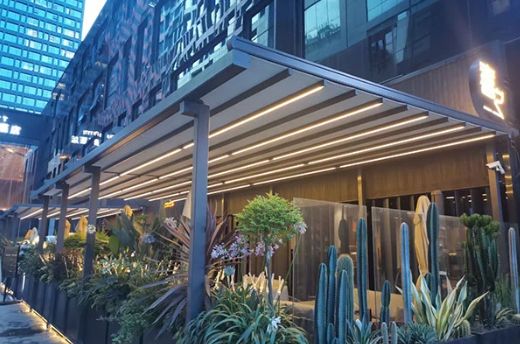
3. Deployment geometry
Folding arms rotate outward and push a front bar away from the façade. The mechanism keeps the area below clear, but width and projection combinations are limited by arm geometry, fabric tension and bracket spacing.
A rail-guided canopy moves fabric-supporting crossbars along fixed tracks. It may be wall-mounted, free-standing or double-sided. That geometry is better suited to a defined outdoor room, while an awning is often the cleaner choice for a balcony or shopfront.
4. Wind exposure and operating condition
Both products create large surfaces when extended. Wind pressure, uplift and dynamic movement depend on size, height, terrain exposure, orientation, fixing and product configuration. “Windproof” is therefore not a responsible universal description for a retractable fabric product.
For an awning, a compatible wind or vibration sensor can support protective retraction, but automation does not remove the need for operating rules. For a canopy, the frame and foundations must be reviewed together with the approved fabric-roof condition. Always confirm the exact operational wind limit and the required response during severe weather.
5. Pitch, runoff and drainage
An awning relies on sufficient inclination to avoid water ponding and maintain head clearance at the front bar. A shallow angle may look discreet but can reduce runoff performance. Dimensions and installation height must therefore be checked together.
A framed canopy can incorporate gutters and posts used as downpipe routes. The design must still consider outlet capacity, discharge location, surrounding floor falls and maintenance access. Water should never be directed toward a doorway, electrical component or pedestrian route.
6. Protection when the system is closed
The principal advantage of a full cassette awning is what happens after retraction: the upper and lower covers close around the fabric, roll tube and folding arms. This reduces direct exposure to dust and weather and creates a clean façade line.
A retractable canopy usually gathers its fabric under a protective cover at one end of the guide rails. The cover arrangement, drainage at the retracted fabric stack and access for cleaning should be confirmed in the shop drawing.
7. Width, projection and modular coverage
A full cassette awning is efficient for façade-based shade across doors, windows and moderate patio projections. Connected units can extend coverage along a longer façade, but every added module introduces bracket, motor, fabric and control coordination.
A canopy frame is better suited to deeper terraces and repeatable bays. The correct question is not “What is your maximum size?” It is “Which module layout provides an appropriate load path, drainage route, fabric behavior and installation sequence for this site?”
8. Motors, controls and accessories
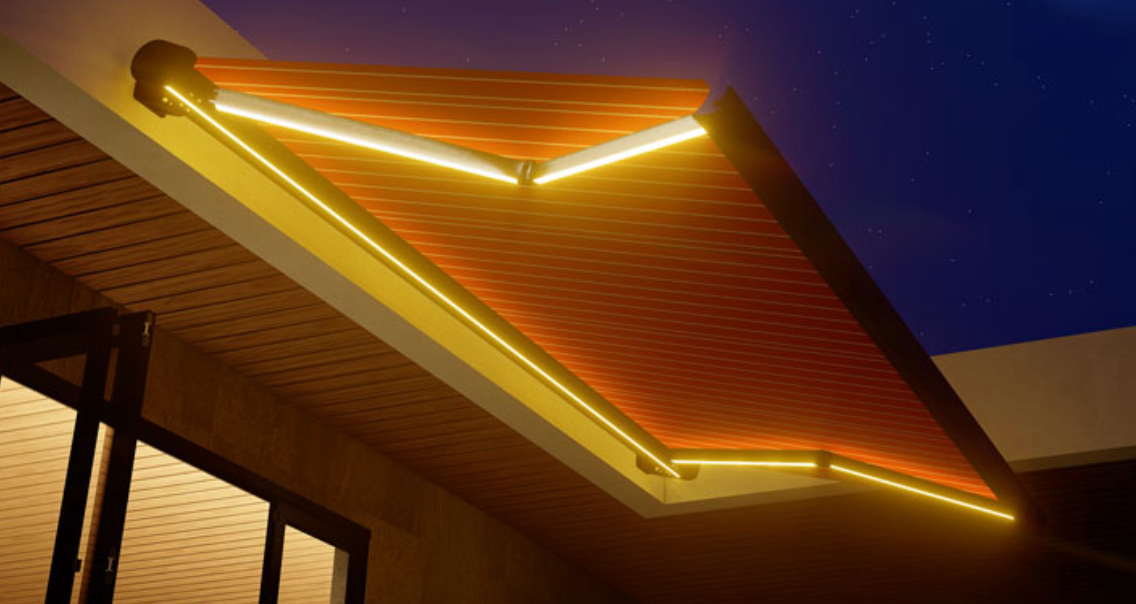
Motorized awnings may use a tubular motor, remote handset, wall switch, smartphone-compatible controller, wind/light/rain sensor, vibration sensor, manual override and integrated LED lighting. A retractable drop curtain can improve low-angle sun control at the front edge.
Canopy systems can also use individual or grouped motor control and integrated lighting. For both products, voltage, motor side, cable route, control channels and future service access must be defined before production—not improvised after installation.
9. Installation and maintenance burden
An awning can be visually simple but concentrates forces at a small number of brackets. Accurate substrate assessment, anchor selection, bracket alignment and commissioning are critical. Periodic maintenance includes cleaning fabric, checking fasteners and arms, and testing motor and sensor operation.
A canopy normally requires more site work: posts or wall beams, alignment of guide rails, drainage, electrical work and module coordination. In return, it creates a more defined outdoor zone. Maintenance also includes rails, gutters, outlets, fabric stack and frame connections.
Awning vs canopy comparison table
| Decision factor | Full cassette awning | Retractable roof canopy |
|---|---|---|
| Primary role | Adjustable façade shade | Adjustable overhead outdoor-room coverage |
| Support | Wall or ceiling brackets | Wall beam, guide rails, posts and foundations as configured |
| Front posts | Normally none | Often required for free-standing or deep coverage |
| Movement | Articulated folding arms | Crossbars travel along guide rails |
| Rain strategy | Inclined water-repellent fabric; project limits apply | Fabric pitch plus planned gutter/outlet route |
| When closed | Fabric and arms enclosed in cassette | Fabric stack protected at rail end |
| Best applications | Balconies, shopfronts, windows and patios | Restaurants, hotels, courtyards and larger terraces |
| Typical options | LED, sensors, drop valance, smart control | Grouped motors, lighting, side screens and drainage |
For projects needing rigid rotating louvers rather than fabric, compare both choices with a motorized louvered pergola. Our detailed guides explain the problems a louvered pergola solves and the benefits of a motorized retractable roof awning.
Watch the motorized full cassette awning operate
During a product review, watch whether both arms extend evenly, the front bar remains aligned, fabric tension looks consistent and the cassette closes cleanly. These visual checks do not replace load verification, but they reveal basic movement quality.
Awning components and accessories that affect performance
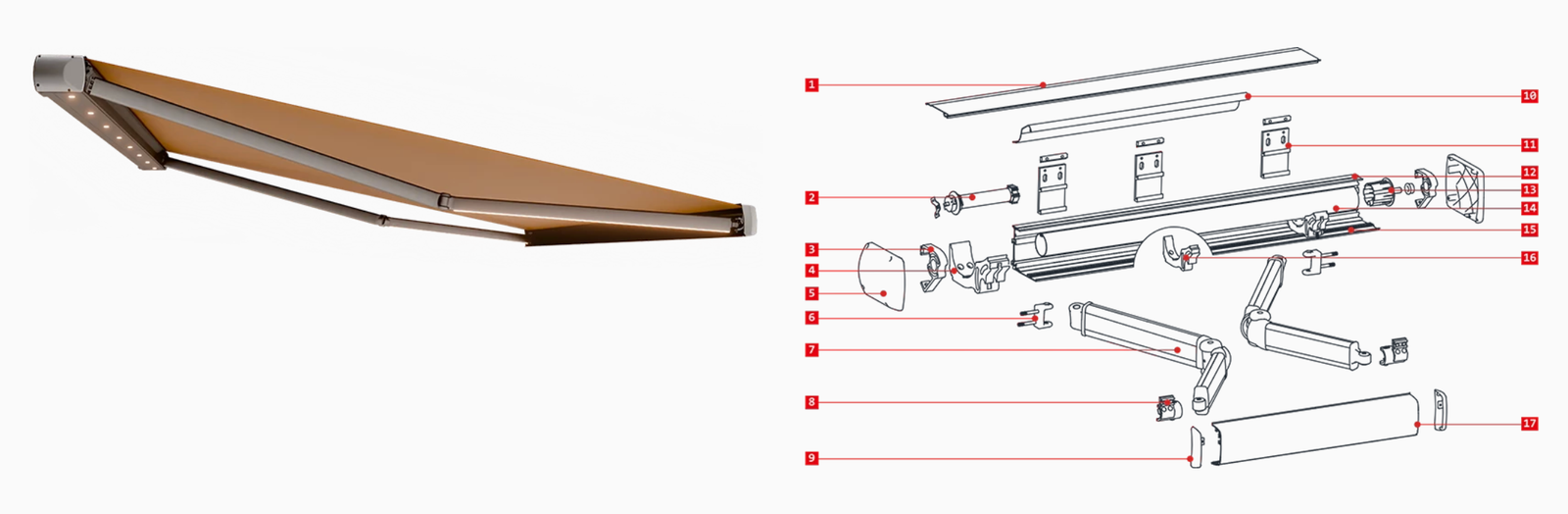
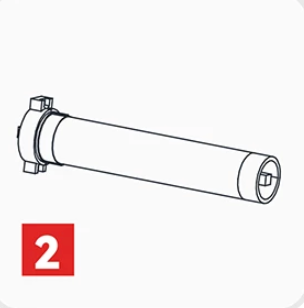
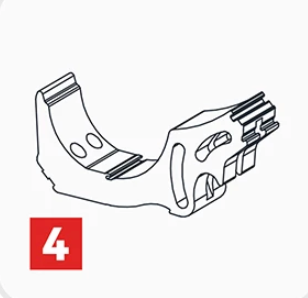
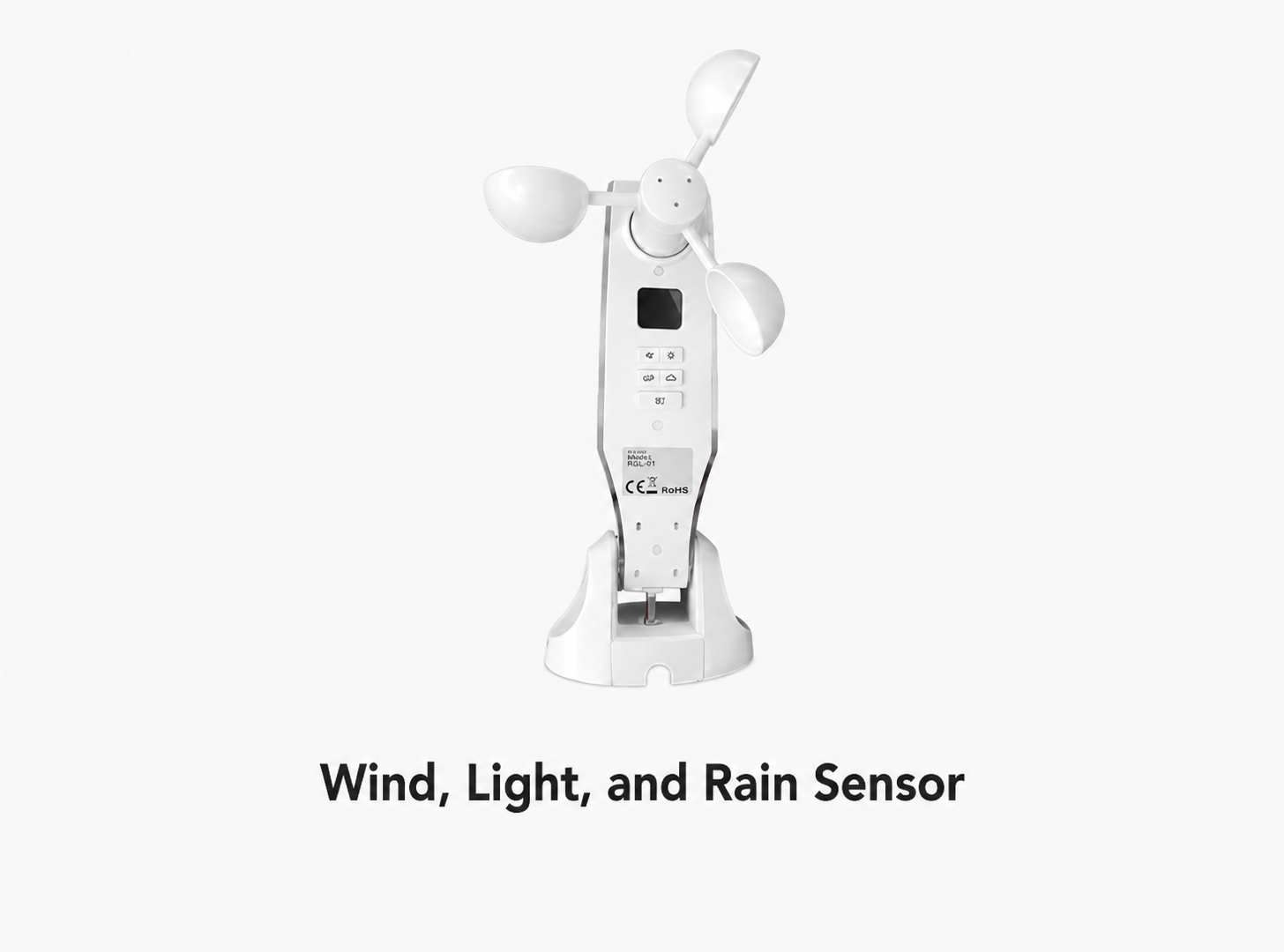
Accessories should be selected as part of the system. A sensor must be compatible with the motor and programmed for the intended operating logic. A manual override needs accessible operation. LED wiring must remain protected through movement. A drop curtain changes the front-bar load and closed cassette space. Ask the supplier to show each option in the order drawing and packing list.
Which outdoor shade system fits your project?
- Choose a full cassette awning when you need clean wall-mounted projection shade, no front posts and protection for the retracted fabric and arms.
- Choose a retractable roof canopy when a restaurant terrace or courtyard needs deeper, rail-guided overhead coverage and coordinated drainage.
- Choose a louvered pergola when rigid rotating louvers, integrated aluminum drainage and a more architectural outdoor room are priorities.
- Choose a cantilever parasol when localized movable shade and minimal construction are more important than large continuous coverage.
- Add motorized zip screens when overhead shade alone cannot control low-angle sun, glare or exposed sides. See the related zip screen problem-solving guide.
Factory preparation: what happens before shipment
A professional awning vs canopy decision continues into production. LINGYUE reviews aluminum profiles, brackets, motors, controls, fabric, accessories, finish, labels and packaging against the confirmed configuration. Long components require protected bundling or export cases, while small components should remain identifiable by project and module.
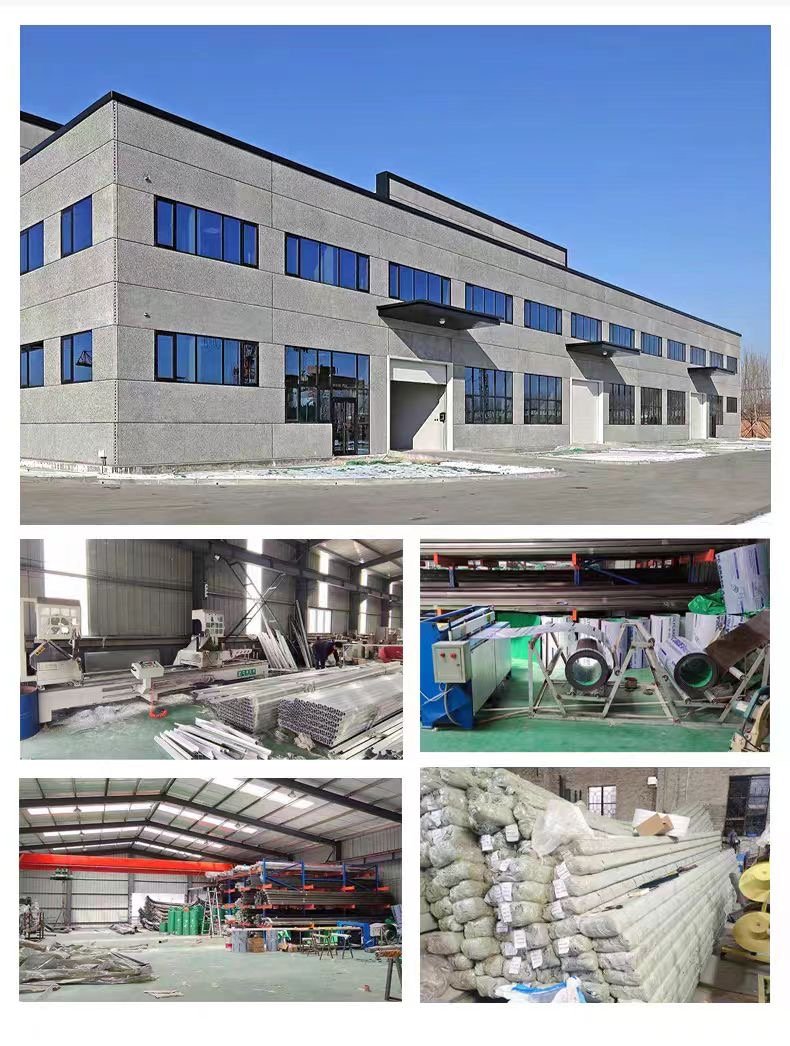
Review the LINGYUE factory workflow, quality-control process and warranty and after-sales approach. More operating footage is available in the product video library.
15-point quotation checklist
- Finished width, projection and available installation height
- Clear site photos of the wall, slab, façade and surrounding area
- Wall or foundation material and any insulation or cladding build-up
- Residential, hospitality, retail or another intended application
- Primary goal: solar shade, glare control, light-rain use or open-sky flexibility
- Site orientation and the time of day when discomfort is strongest
- Building height, terrain exposure and local environmental loads
- Required pitch, head clearance and water discharge location
- Frame, fabric and powder-coat color requirements
- Motor voltage, control method and cable route
- LED lighting, sensors, manual override or drop-curtain options
- Individual or grouped control for multiple modules
- Applicable local code, approval and documentation requirements
- Delivery address, access restrictions and lifting method
- Quantity, destination country and required shipping date
Awning vs canopy FAQ
Is an awning the same as a canopy?
No. An awning is usually a building-attached shade that projects outward, while canopy is a broader term for overhead cover. Some suppliers use the terms interchangeably, so compare structure, movement, drainage and operating limits rather than the label alone.
Can a retractable awning be used as a rain canopy?
A suitably inclined awning with an appropriate outdoor fabric can shed limited rain in approved conditions, but it should not be sold as a universal storm roof. Confirm fabric, pitch, projection, runoff, wind exposure and the manufacturer’s operating guidance.
Which option is better for a restaurant terrace?
A full cassette awning is effective for façade-side tables and a clear floor area. A rail-guided canopy is often better for deeper or multi-bay terraces that need a defined overhead zone. Table layout, drainage, staff operation and site exposure should drive the choice.
Does a motorized awning need a wind sensor?
A compatible sensor is a useful protective accessory, especially where staff may not notice changing conditions. It does not make the awning windproof and does not replace user training, approved limits or manual retraction before severe weather.
What information is needed to choose between an awning and canopy?
Provide width, projection, installation height, substrate, site photos, orientation, application, destination, weather exposure, drainage preference, control requirements and accessories. These inputs allow the supplier to compare feasible systems instead of quoting a generic maximum size.
Can the awning fabric and frame color be customized?
Yes. Full cassette systems can be configured with selected powder-coat colors, outdoor fabrics, logo printing, lighting and control options. Final availability and color matching should be confirmed with physical samples or an approved finish reference.
Turn the awning vs canopy question into a project specification
Send LINGYUE the size, application, destination and site photographs. Our technical team will review the feasible product type, projection, support, pitch, fabric, motor, controls, accessories, drainage and packaging requirements.
Technical note: Product dimensions, load capacity, weather suitability, control logic and installation method remain subject to the confirmed configuration and local requirements. This guide supports product selection; it is not a site-specific structural calculation.
In this guide
Featured products
Watch & follow